Before You Go
Meili Wyss • Last updated: July 22, 2026 • 8 min read
Here is what most festival camping essentials lists won’t tell you: the packing list is the easy part. The things that actually decide your weekend in an RV are a 20-gallon math problem, a gate policy, and a generator curfew. You need to know all three before you book, not when you’re parked in a field on day two.
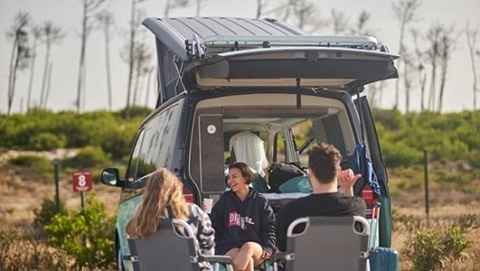
An RV at a music festival is a real advantage. Bed, fridge, locked door, air conditioning. But the lot you’re parking in is not an RV park. It’s a field with portable toilets, and everything your camper needs for four days of music festival camping rides in with you.
This guide covers what to bring, and the five things that catch first-timers. Every one of them is avoidable if you know it’s coming.
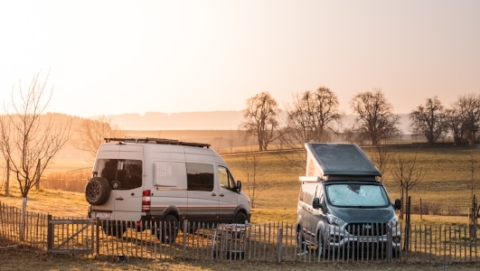
Almost every festival RV lot is dry camping: no electric, water, or sewer hookup at your spot. Your camper runs as a closed system. Fresh-water tank in, gray and black tanks out, battery for power, and nothing refills or empties itself until you leave.
That single fact drives every real decision. How much water you carry. Whether you need generator fuel. How many showers your tank can actually absorb. Get the closed-system logic and the packing list writes itself; skip it and no checklist will save you. If RVing is new to you, roadsurfer’s RV guides cover the fundamentals this article builds on.
Hookups do exist, but as the exception. Bonnaroo made all RV passes powered for 2026, with a 30- or 50-amp option. That is a genuine shift, and new enough that most advice online still says the opposite. At the Albuquerque International Balloon Fiesta, every tier is dry camping except the $300-a-night President’s Compound. The pattern: assume dry, verify on the event’s current RV page, and treat power as a bonus if you find it.
The plan of “we’ll just drive out and dump the tanks midway” does not survive contact with a festival. At Bonnaroo, leaving the campground is allowed but heavily discouraged: it costs $40 per re-entry, you have to scan out and pre-pay before you go, and inbound traffic can pin you inside until Friday evening, according to the festival’s official RV rules. Other events are similar or stricter.
The mobile pump-out service isn’t a convenience. It’s the plan. Bonnaroo runs water refill and tank pumping through United Site Services at $75 per service; the Balloon Fiesta’s on-site vendor charges $50 per pumping. Budget for one service on a long weekend, or arrive with enough tank capacity to never need it. If you’re in a rental, roadsurfer stations have waste-tank disposal stations for dumping before you return it.
This also changes how you arrive: full fresh-water tank, empty gray and black tanks, fuel topped off. You get one free move, the drive in. Spend it well.
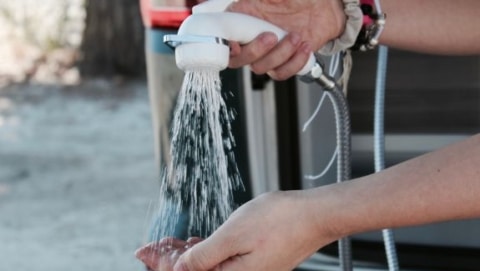
The tank that ends most festival RV weekends early isn’t the toilet. It’s the gray tank, where every drop from your sink and shower ends up. The math is unforgiving. A standard showerhead pushes about 2.5 gallons a minute, so two 4-minute showers send roughly 20 gallons into that tank. A camper van’s gray tank typically holds just 8 to 30 gallons.
Run the numbers for your own rig: two people showering daily can fill a small gray tank by the second morning. In the desert dust of a summer festival, nobody skips the shower voluntarily.
The fix is technique, not suffering. A navy shower (wet down, water off, soap up, quick rinse) uses under 2 gallons. Wash dishes in a tub instead of under a running tap. Drink from jugs so the fresh tank stays for washing. And check your gray gauge daily, because it always reads lower in your head than on the panel.

Generators are allowed at most festival lots, but on a curfew. The Balloon Fiesta caps them at 80 decibels, wants external units two feet off the ground, and enforces quiet hours from 10:30 p.m. to 3:30 a.m., per its official RV park rules. Expect a version of this everywhere.
Why it matters: air conditioning is your camper’s hungriest appliance, and it generally needs the generator or a hookup. The battery alone won’t carry it. Quiet hours mean no generator, which means no AC, right when you’re trying to sleep.
The tactic is to work the clock. Run the AC hard in the last hour before curfew, close the rig up, and let the insulation hold the temperature. Desert festivals flip the problem after midnight: the same rig that baked at 4 p.m. gets cold, so a warm layer for sleeping earns its space in the bag. A CPAP or anything else that must run overnight needs its own battery bank; quiet hours don’t make exceptions.
Some festivals only admit self-contained RVs, and the term has a specific meaning: an onboard toilet, a fresh water supply, and holding tanks for wastewater. A portable toilet in a privacy tent outside your van does not count. The Balloon Fiesta lists self-contained as its single most important requirement.
If you’re renting, this is a booking-stage question, not a packing question. Confirm the specific RV model you’re reserving has an onboard toilet before you commit to a festival that requires one. roadsurfer’s Sprinter-style RVs list what each model carries, and it’s a two-minute check that saves a turned-away rig at the gate.
Most festival RV lots park “rally style”: rigs go into spots in the order they arrive, no assignments, no saving spaces. That one rule creates three consequences worth planning around.
First, early arrival buys location. At Bonnaroo, the earlier you reach the Farm, the closer you camp to the stages. Second, camping next to friends only happens if you arrive together; meet up 40 minutes out and drive in as a convoy, because separate arrivals mean separate corners of a very large field. Third, arriving late can mean not parking at all until morning. The Balloon Fiesta stops parking rigs after dark and stages late arrivals overnight.
There’s a real trade-off hiding in “get there early,” though: close to the stages also means close to the noise, and you’re committed to that spot for the duration. Decide which you value before the gate, not in line.
The best RV camping tips all share one habit: pack for the problem, not the list. Every item below solves a specific festival problem. Know the problem and you’ll never forget the item. For a full RV packing list beyond festivals, use roadsurfer’s RV camping packing list as your master checklist.

The RV buys comfort and self-sufficiency; the tent buys simplicity and a smaller bill. Neither is wrong. They’re different bets.
| Factor | RV / camper van | Tent |
|---|---|---|
| Sleep | Real mattress, off the ground | Pad or air mattress |
| Heat and cold | Fan/AC and furnace (generator rules apply) | The weather wins |
| Power | Battery + generator or solar | Power banks only |
| Water and bathroom | Onboard tanks and toilet | Spigots and portable toilets |
| Security | Lockable, weatherproof | Valuables at risk |
| Cost | Rental + RV pass + fuel | Tent + camping pass |
| Flexibility once parked | Committed to the spot | Move anytime |
If sleep, temperature, and a locked door matter to you, the RV pays for itself by Saturday. If you pack light and sleep anywhere, keep the tent and spend the difference on tickets.
Many major US festivals offer RV camping, though the format ranges from bare dry-camping fields to premium sites with hookups. Bonnaroo in Tennessee and the Albuquerque International Balloon Fiesta in New Mexico both run dedicated RV programs, and music festival camping with an RV option is standard at most large multi-day events.
Because rules, prices, and availability change every year, and sometimes sell out months ahead, always confirm the details on the festival’s official RV or camping page before you plan around it. For the nights on either side of the festival, roadsurfer’s RV parks guide explains where else you can park and what hookups to expect. Treat any list you find online, including this one, as a starting point, not a guarantee.
Event rules and prices in this guide were verified against official festival pages in 2026. Always check the current year’s rules before booking.
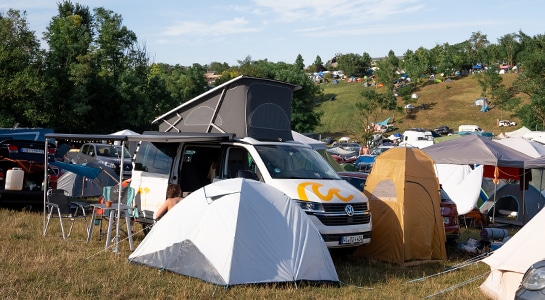
The rig is the easy part. Of all the festival camping tips in this guide, three decide the weekend: a closed water loop, a gate that punishes exits, and a curfew on your power. Sort those before you leave the driveway and the RV does what it promised: a bed, a cold fridge, and a door that locks, fifty yards from the music.
Yes, most festivals with camping sell a separate RV pass per vehicle, plus a ticket per person. Before booking, check the size limit (Bonnaroo counts anything over 20 feet or towing as an RV), whether trailers and box trucks are banned, and whether the event requires a self-contained rig.
Usually not; most festival RV camping is dry camping, so you run on battery plus a generator or solar. Some events are adding power, though. Bonnaroo made all RV passes powered for 2026. Verify on the festival’s current RV page each year, because this is changing fast.
Plan as if you can’t; many festivals discourage leaving and charge a re-entry fee. Bonnaroo charges $40 to re-enter and traffic can trap you inside until Friday evening. Arrive with empty tanks and budget for the on-site mobile pump-out, typically $50 to $75 where offered.
For dry camping, yes, if you want AC or need to recharge daily. The battery alone won’t run air conditioning. Check the event’s rules first: noise caps around 80 decibels and overnight quiet hours are standard, so anything that must run all night needs its own battery bank.
Arrive with a full fresh-water tank plus separate drinking-water jugs. Treat the gray tank as the real limit: showers at 2.5 gallons a minute fill a camper van’s 8 to 30 gallon gray tank fast. Navy showers and a dish tub stretch your capacity across the weekend.
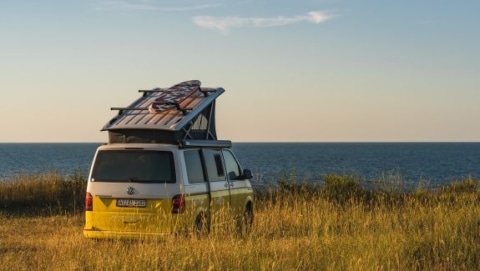
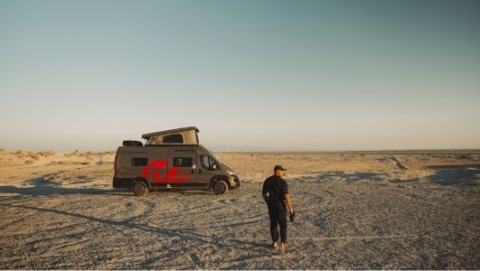
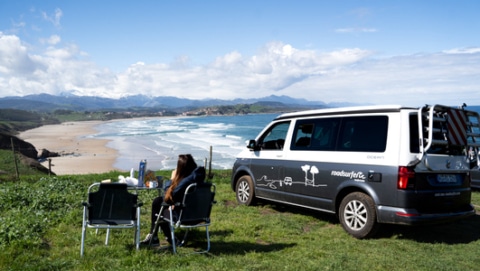

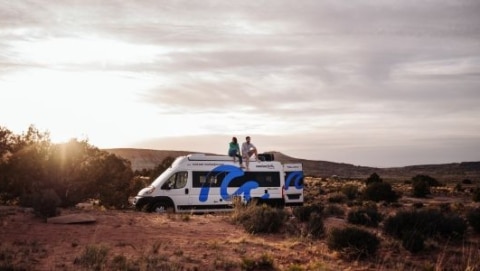
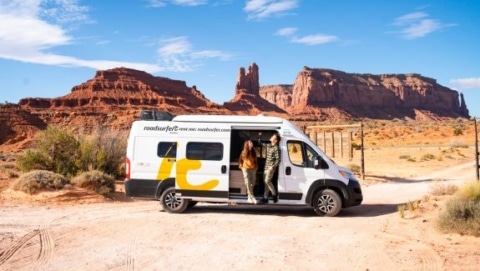
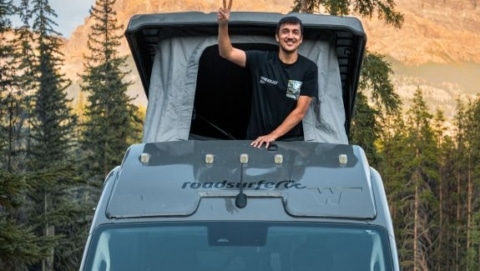

Skip the tent. A self-contained Sprinter-style RV gives you a bed, a fridge, onboard power, and a locked door, fifty yards from the music.
Browse Sprinter-style RVsTravel smarter with roadsurfer.
Trusted by thousands of travelers worldwide.
✓ Backed by 20,000+ Google reviews
✓ Built for families, couples & adventurers
✓ Inspiration & exclusive deals for subscribers