Camping Guides

Meili Wyss • Last updated: August 18, 2026 • 6 min read
The best camping gadgets solve a real problem, pack small, and work without installation — a headlamp, a rechargeable lantern, a power bank, a water filter bottle, and a mosquito repeller cover most trips. Everything on this list fits in a duffel and works in a tent, a rental RV, or your backyard.
That last part matters more than it sounds. Most gadget lists assume you own your rig and don’t mind drilling into it. If you’re renting an RV or camper van — see our RV travel guides for the basics — you need gear that arrives with you and leaves with you. Every pick below passes that test.
One rule before you buy anything: a gadget earns its spot by solving a problem you can name. The collapsible avocado slicer does not qualify.
| Gadget | Solves | Typical price |
|---|---|---|
| Headlamp | Hands-free light | $25–$40 |
| Rechargeable lantern | Camp and table light | $35–$80 |
| Power bank (10,000+ mAh) | Dead phones | $25–$50 |
| Portable power station | Laptops, CPAP, fridge boosts | $200–$500 |
| Foldable solar panel | Off-grid recharging | $100–$300 |
| Water filter bottle | Safe drinking water anywhere | $70–$100 |
| Portable mosquito repeller | Bug-free camp zone | $60–$80 |
| Quick-dry towel | Wet gear, small space | $20–$30 |
| Compact camp chair | Sitting like a human | $50–$150 |
| Manual coffee maker | Real coffee, no machine | $40 |
| Collapsible kitchen gear | Washing up in a small sink | $15–$40 |
| Multi-tool | Everything else | $50–$130 |
Prices are typical U.S. street prices as of 2026 and vary by retailer.
A headlamp — the one gadget every camper should own before any other. Both hands stay free while you cook, set up, or find the bathroom at your camping spot at 2 a.m., which is the whole argument.
Entry-level models like the Petzl Tikkina run about $25 and handle everything short of caving. Look for a red-light mode: it preserves your night vision and doesn’t blind the person across the table. One per person, not one per group. The person holding the only light always ends up doing the dishes.

With a lantern — it lights the space instead of whatever you’re staring at. Set it on the table, hang it in the awning, and camp suddenly has rooms.
USB-rechargeable models have quietly killed the gas lantern for most campers: no mantles, no fuel, no hiss. The Goal Zero Lighthouse 600 (around $80) doubles as a power hub for your phone, and budget options like the Crush Light cost about $35 and pack flat. Warm light beats cool white — 3000K feels like a kitchen, 6000K feels like an interrogation.

A 10,000 mAh power bank brings it back — roughly three full phone charges, which covers a weekend of navigation, photos, and the podcast that gets you through the drive. It’s the cheapest insurance on this list.
Get one with two ports and USB-C fast charging. If you’re in an RV, the vehicle charges it while you drive; at a tent site, it is the grid. Charge it the night before you leave — the power bank that stays in the drawer at 12% helps no one.

For most campers, 200 to 500 watt-hours — a big battery with real outlets that runs laptops, camera batteries, a CPAP machine, or a cooler booster for a weekend. It’s also the most overbought gadget in camping.
Be honest about your load. Phones and lights alone? A 10,000 mAh power bank does it for a tenth of the price. Remote work, medical devices, or several days without hookups? Then a station in the $200–$500 range earns its 6–12 pounds. One caveat worth knowing: driving does charge a rental’s house battery, but slow, short drives barely move it, and even a long highway stretch takes several hours to make a real dent — shore power is the reliable top-up. If you’ll mostly be plugged in, you need less standalone power than you think; if you’re off-grid for days, plan to bring more.

Between 10 and 100 watts, depending on the job. Small 10-watt panels (about $100, half a kilogram) top up phones on the move; 100-watt panels keep a power station alive indefinitely — wherever the sun cooperates.
Solar is slower than everyone hopes — clouds, shade, and bad panel angles all tax the output. Treat it as a range extender, not a power plant, and size it to the battery it feeds.

With a purifier bottle, yes. The Grayl GeoPress turns questionable water into drinking water in about eight seconds per press — no pumping, no waiting, no chemistry set. Press, drink, done.
It covers the tap at your camping spot with the “non-potable” sign, the mountain stream, and the gas station spigot you’d rather not think about. For RV travelers it also solves the fresh-tank question: filter what you drink and the tank’s history stops mattering. Expect to pay around $100 and replace the cartridge after roughly 350 presses.

Yes, surprisingly well. A butane or rechargeable repeller like the Thermacell EL55 (around $60–$80) builds a roughly 20-foot bug-free zone in about 15 minutes, no spray and no smoke. Dusk at camp becomes sitting outside instead of hiding inside.
It needs still air to work well — on a windy ridge, save the refill. Pair it with regular repellent for hikes; the device protects the camp, not the camper in motion.

Because it’s cotton, and cotton never really dries at camp. A microfiber towel dries in a fraction of the time and packs to the size of a paperback. In the small, damp world of a tent or an RV bathroom, that’s the difference between a towel and a science experiment.
They cost $20–$30, weigh a few ounces, and double as a beach mat, a dish dryer, and a dog wiper — usually in that order, occasionally all in one day. Bring two.

Packed size and weight first — compact folding chairs now weigh under two pounds and pack to the size of a wine bottle. The chair is where most of camping happens, so a good one out-earns almost every gadget above it.
Two schools: minimalist chairs like the Helinox Chair Zero pack tiny but sit low, and higher models (around $150) spare your knees getting up. Renting from roadsurfer? Two camping chairs are already included with every camper — see everything that’s included with your rental. Sit in one before buying if you can — chair comfort is stubbornly personal.

With an AeroPress and hot water — nothing else required. It makes genuinely good coffee, weighs almost nothing, and cleans up in one wipe. At around $40 it’s the highest morale-per-dollar item on this list.
There is no view good enough to fix bad coffee. Grind at home, pack it in a jar, and the first ten minutes of every camp morning are handled. Tea drinkers: an insulated food jar keeps water hot from breakfast through the trailhead.

With gear that flattens. Collapsible silicone tubs, kettles, and measuring cups pack down to almost nothing and turn a tiny camp kitchen into a workable one. A collapsible wash tub ($15–$40) is the sleeper hit: dishes, feet-washing, ice bucket, laundry.
Skip the single-purpose novelties. If it only does one job and that job happens once per trip, it’s paying rent it can’t afford.

A quality multi-tool, ideally — pliers, knife, scissors, screwdrivers. It handles the loose screw, the stubborn packaging, the splinter, and the bottle without a visible opener. The Leatherman Wave+ (around $130) is the standard answer; simpler models start near $50.
Keep it in the same pocket of the same bag every trip. A multi-tool you can’t find is a paperweight you can’t find either. If you’re flying to your rental pick-up, remember it belongs in checked luggage — security bins are full of confiscated ones.

Most “best camping gadgets” lists waste money on solutions hunting for a problem, and plenty of cool camping gadgets are cool for exactly one use. Skip single-use kitchen tools, anything requiring installation in a vehicle you don’t own, gadget versions of things you already have (your phone is a fine star map), and heated anything with a battery life measured in minutes. When in doubt, name the problem the gadget solves. No problem, no packing space.
Start with a headlamp, a power bank, and a rechargeable lantern — together under $150. That covers nearly every trip. Add a water filter bottle and a mosquito repeller next if water quality or bugs are a factor where you camp.
Mostly no — every item on this list works for both, which is the point. RV travelers can often skip big power stations since the vehicle’s house battery covers phones and lights. Tent campers should prioritize light and power first.
A starter kit — headlamp, lantern, power bank, towel, and multi-tool — runs about $150 to $250. The full list here lands between $700 and $1,400 depending on choices, though few people need everything at once. Let each trip reveal what’s missing before you buy more.
Check what the rental already includes before buying anything for it. A kitchen set and two outdoor camping chairs with a table come standard with most rentals, so check the included-equipment list before duplicating any of it — you can also book extra camping equipment if you need more. Favor gadgets that need no installation, since modifying a rental isn’t an option.
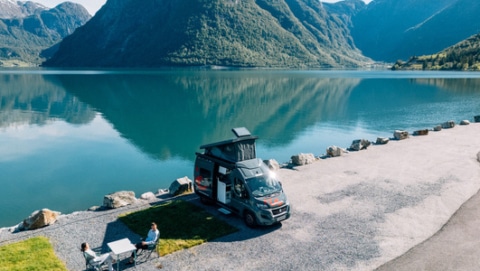
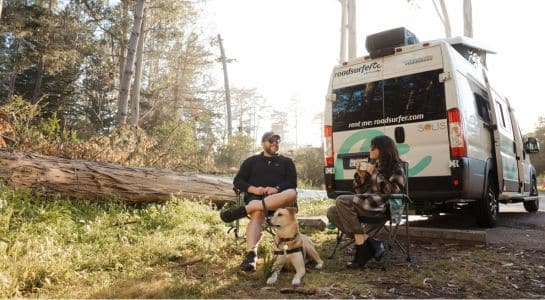
Kitchen set, camping chairs, and table come standard — just add your favorite gadgets
The pattern across every good camping gadget is the same: small, self-contained, and aimed at a real annoyance — darkness, dead batteries, bad water, bugs, bad coffee. Start with the basics, cross-check them against our RV camping packing list, and let each trip tell you what was missing. New to renting altogether? Our RV camping basics guide covers the fundamentals first. Ignore anything that needs a drill — your future self, sitting in a decent chair with a working headlamp and a full cup, will confirm you chose well.
Find Your Camper VanTravel smarter with roadsurfer.
Trusted by thousands of travelers worldwide.
✓ Backed by 20,000+ Google reviews
✓ Built for families, couples & adventurers
✓ Inspiration & exclusive deals for subscribers