Before You Go
Meili Wyss • Last updated: August 11, 2026 • 11 min read
Camping alone as a woman is safe enough that thousands of women do it every weekend, and uncomfortable enough that most of them remember their first night. Both things are true.
The gap between those two facts is filled almost entirely by preparation, which is good news, because preparation is something you can do sitting at your kitchen table.
This guide covers the two questions that stop most people before they book — is it safe, and will I be lonely — then moves to the practical part: choosing between a tent and a camper van, planning a first trip you can actually finish, and what to put in the vehicle.
If you’re new to camper travel generally, our RV travel guides cover the mechanical side.
Camping alone is generally safe, and the risks that actually derail solo trips are logistical rather than violent: arriving after dark, a site that looks nothing like its photos, a dead phone with no downloaded map. Harassment does happen, and pretending otherwise would be dishonest. It is also not the thing most likely to go wrong on your first trip.
The National Park Service is direct about solo travel. Its official guidance states that it is safer to travel with a companion, and that if you go alone you should take extra measures because you’ll be on your own. That’s the right frame. Not don’t go — go differently.
Three of those extra measures do most of the work.
A few habits experienced solo campers share. Park facing out, so leaving doesn’t require a three-point turn at midnight. Keep your keys somewhere you can find them without a light.
Don’t announce that you’re alone — not out of paranoia, but because there’s no reason to.
And trust the feeling if a site is wrong. You are allowed to drive away from a place you already paid for. One night’s site fee is a cheap price for sleeping well.
Camping alone is quieter than camping with people, which is usually the point, and lonelier than expected on exactly one evening — the first one. The pattern most solo campers describe is a restless first night followed by a second day where the appeal finally lands: nobody negotiating the schedule, nobody to please.
The practical fix is to bring something to do with your hands. A book works. So does cooking a real dinner instead of eating crackers over the sink, or a short hike you’ve already picked so you’re not deciding at 4 p.m. what to do with the rest of the day.
Structure helps more than company does.
Camping spots are also more social than they look. Hosts talk. Neighbors ask where you’re headed. If you want that side of it, our guide to making friends while camping covers how it usually happens, which is mostly by accident near a water spigot.
Solo camping past 50 is a growing group, not a novelty, and the practical concerns shift rather than multiply. The questions get more specific: how far is comfortable to drive in a day, how much setup can my back tolerate, how close do I want to be to a bathroom and to cell service.
Those constraints argue for a camper van over a tent more strongly than anything else in this guide. Sleeping off the ground matters more at 58 than at 26. So does standing up to change clothes, heating the space without going outside, and not kneeling on gravel to pack up in the morning.
Two adjustments worth making. Cut the daily drive to 150 to 200 miles rather than 300, because fatigue compounds without a second driver. And book sites with an electric hookup where you can, so heat and charging don’t depend on how sunny the afternoon was.
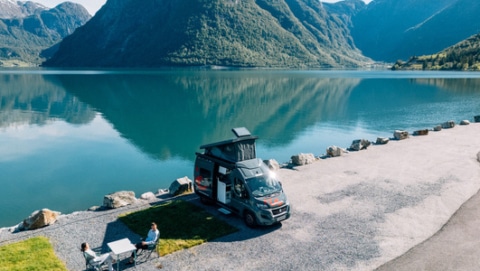
A camper van solves the specific problems that make solo camping stressful: it’s a hard shell rather than fabric, it’s already set up when you arrive, and it lets you change your mind and drive somewhere else. A tent is cheaper and reaches places a van can’t. For a first solo trip, the van removes more friction.
| Camper van | Tent | Cabin | |
|---|---|---|---|
| Solid walls | Metal and glass, locks like a car | Nylon and a zipper | Solid walls, locking door |
| Setup after dark | Park and you’re done | 15–30 minutes, by headlamp | Desk hours only |
| Weather protection | Sealed, heatable | Exposed | Sealed |
| Gear while you hike | Locked in the vehicle | Unattended in a tent | Locked in the cabin |
| Changing plans | Drive away | Pack up first | Usually non-refundable |
| Cost per night | Rental plus site fee | Site fee only | Highest |
| Where you can stay | Camping spots, RV parks, many dispersed areas | Camping spots, backcountry | One fixed location |
The solid-walls row is the one that changes how a night feels. It isn’t really about intruders. It’s about not lying awake doing math on how thin nylon is, and about knowing the option to leave stays available all night even when you don’t use it.
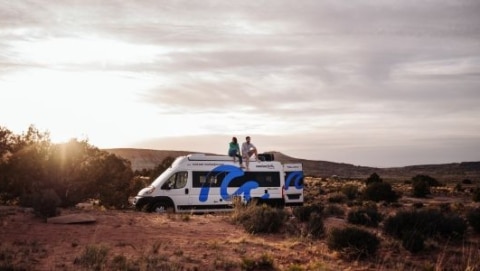
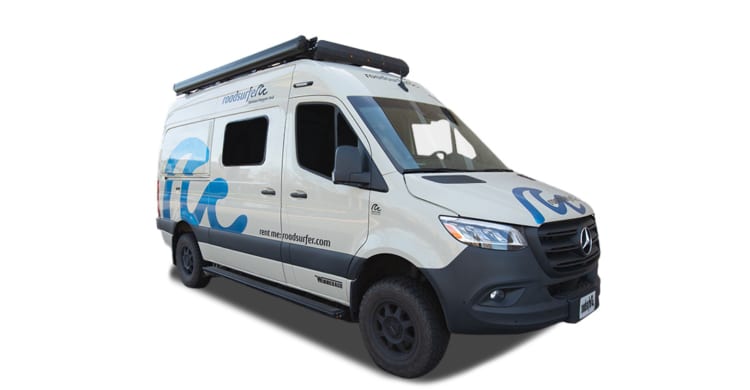
Size is a real trade-off rather than a detail. Something shorter is easier to park and less tiring to drive on an unfamiliar road at dusk. Something longer gives you more room to move around inside on a rainy afternoon. roadsurfer calls its sprinter-style camper vans a medium size, and every one of them has a wet bath with a shower and toilet, so an indoor bathroom is not the thing you trade up for. roadsurfer positions the Horizon Hopper for solo travelers and couples specifically — it’s a Sprinter, so it drives like a van rather than a car, but it carries a warm indoor shower and toilet, heating that runs with the engine off, and blackout blinds for the windows and windshield.
To rent in the US you need to be at least 21, hold a standard class B license, and have held it for more than a year. No special license is required.

Start smaller than you think you should. A first solo trip that works is usually two nights, under three hours from home, somewhere with a host on site and a reservation already in hand. Ambition is for the third trip.
Work in this order:
If you’ve never used a camper van before, our guide to RV camping walks through the first-day mechanics — hookups, leveling, and where the water goes.
One more piece of pacing advice from the RV world: the 3-3-3 guideline. Drive no more than 300 miles in a day, arrive by 3 p.m., and stay three nights before moving. It’s a community convention rather than a rule, and for a first solo trip it’s close to ideal.
The fear of driving alone shrinks with exposure and specific practice, not with reassurance. It usually isn’t fear of driving. It’s fear of a particular scenario: merging onto a highway in an unfamiliar vehicle, backing into a site with someone watching, or breaking down somewhere with no signal.
Practice the specific thing. Take the van to an empty parking lot and back it into a space six times. Find the reverse camera and the mirrors before you need them.
Drive it around your own neighborhood, where you already know the roads, so the only new variable is the vehicle.
Then reduce the unknowns on the drive itself. Plan fuel stops in advance rather than watching the gauge. Know the vehicle’s height and write it on a sticky note by the mirror, because low clearances are the mistake first-timers make most. Keep driving days short — 300 miles is a long day in a camper van, and four hours feels like six when you’re the only driver.
The thing that dissolves most of this fear is a single uneventful trip. Confidence isn’t available in advance; it’s a souvenir.
Pack for the two problems you’ll actually have: it gets dark earlier than you planned, and there’s nobody to hand you a tool. Everything else is comfort.
Our full RV camping packing list covers the vehicle-specific gear.
The best first solo destination is a well-reviewed state park within a three-hour drive of home. Familiar region, short drive, staff on site, and a bail-out option if the first night goes badly. Save the remote and dramatic places for when the routine is boring.
State parks are the sweet spot for a first trip, and Florida’s system is a useful model of what to look for: reservable sites with electric hookups, restrooms within walking distance, a ranger station that’s actually staffed, and enough other travelers that you’re not alone in the dark without having chosen to be. Our guide to Florida state parks for RV camping shows how those features stack up in practice.
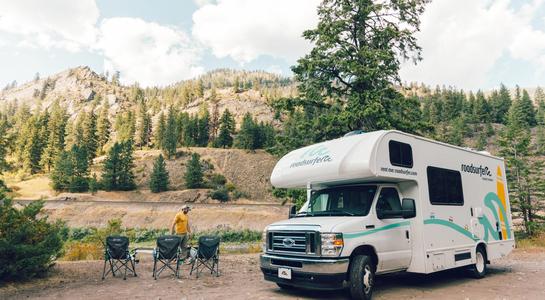
National parks are the obvious next step. The constraint there is booking rather than difficulty — the six-month Recreation.gov window is real and competitive at the popular parks.
Dispersed camping on public land is the version most people picture when they imagine solo camping. No neighbors, no fee.
It’s also the version to work up to. On Bureau of Land Management land, dispersed camping is generally limited to 14 days within any 28-day period, after which you move to a new location, often 25 to 30 miles away. Most areas don’t require a permit. You’re asked to stay at least 200 feet from lakes, rivers, and streams, and to camp within 150 feet of designated routes rather than cutting new tracks.
Go there on your third or fourth trip, once you already know how you sleep.
Our RV parks guide breaks down the differences between park types, hookups, and costs.
Most solo campers structure the day around one planned activity and let the rest stay loose. A hike you picked before you arrived, a town to drive into, or a lake to sit beside gives the day a spine without turning it into an itinerary. A first trip goes better with one thing on the schedule.
The 3-3-3 rule is a guideline: drive up to 300 miles, arrive by 3 p.m., stay three nights. It isn’t an official regulation, just a convention that prevents the two most common trip mistakes — driving too far and arriving too late. Some travelers prefer a gentler 2-2-2 version.
Break the drive into segments of two hours or less and stop at every one. With no second driver and no conversation, fatigue arrives earlier than on the same drive with company. Capping the day at 300 miles and arriving mid-afternoon does more for alertness than caffeine.
No — solo camping is common enough that hosts and rangers won’t blink. The self-consciousness is real on a first trip and it fades by the second morning. If anyone asks whether you’re alone, “meeting friends later” is a complete sentence.
Camping alone as a woman is mostly a planning exercise wearing a courage costume. Book a state park two hours from home. Leave a trip plan with someone who isn’t coming. Arrive while it’s light. Bring a chair and a good dinner.
The first night is the hard one. The second morning is why people keep doing it.
Explore Sprinter-Style Camper VansTravel smarter with roadsurfer.
Trusted by thousands of travelers worldwide.
✓ Backed by 20,000+ Google reviews
✓ Built for families, couples & adventurers
✓ Inspiration & exclusive deals for subscribers