Travel Smart
Meili Wyss • Last updated: August 7, 2026 • 6 min read
One Death Valley camping spot advertises “Water, sewer, and 30/50 amp electric connection.” Its site type reads “STANDARD ELECTRIC.” That is a full hookup spot whose own label mentions neither the water nor the sewer.
Reservation listings do that constantly. The fields come from a shared federal data standard, but the labels drift between the standard and the page you actually read, and sometimes within a single page. An Olympic National Park spot lists its type as “WALK TO” and its access as “Hike-In,” then says permitted equipment is “Tent, Hammock” and marks that mandatory. Those last two fields mean an RV cannot use it. Neither of the first two says so.
This guide decodes the fields and labels you are most likely to meet on Recreation.gov and similar systems: what full hookup, partial hookup and no hookup give you, what the driveway and access labels mean, what amp service you can draw, and whether your vehicle will physically fit. If you have not booked yet, our guide to how to plan a camping trip covers the decisions that come before this one.
Full hookup means sewer, water and electricity are all available at the camping spot itself. Partial hookup is an industry term rather than an official one, and usually means electricity and water but no sewer. No hookup means none of the three, so an RV runs on its own fresh water tank, waste tanks and battery until you leave.
The catch is that “full hookup” is not a field in the federal camping data standard. Recreation.gov stores electricity, water and sewer as three separate attributes, and the site type label can hide what is actually there, as the Death Valley listing above shows.
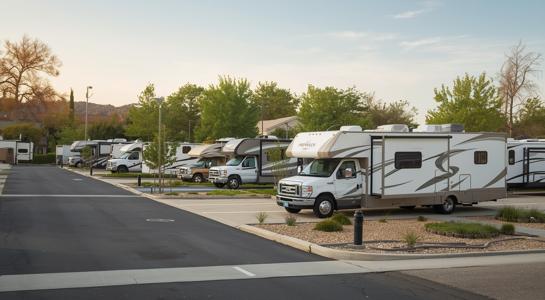
Whether you need full hookup is a separate question from what it means. It costs more, and the gap is not small: New York state parks add $13 to $15 a night for full hookups on top of a $17 standard rate, and Washington charges $46 to $56 for full-utility spots in peak season against $31 to $43 for standard ones.
Without hookups you are running on the vehicle’s own fresh water tank, waste tanks and house battery, so how long that lasts depends entirely on the model. Get those capacities from the rental spec sheet before you assume a no-hookup spot works for your trip. Full hookup earns its money on longer stays, in hot weather when air conditioning has to run, or when you would otherwise be hunting for a dump station mid-trip.
Here is every field you are likely to meet, what it means, and why it matters, grouped into the three things a listing is actually telling you. The terms are not applied consistently, so treat the site type as a summary that may be wrong.
| What the listing says | What it means | Why it matters |
|---|---|---|
| Full hookup | Water, sewer and electric at the spot | Not a single federal data field, so a full-hookup spot can carry a site type label that mentions neither water nor sewer. |
| Partial hookup | One or two utilities, usually electric and water but no sewer. An industry term, not an official one | You will need a dump station for waste water. |
| No hookup | No utilities. The wording varies by park; Capitol Reef’s is “there are no utility hookups available” | In an RV you are running on your own battery, fresh water tank and waste tanks. |
| Dump station | A sewage inlet for emptying RV waste tanks. Sometimes on site, sometimes nearby, sometimes absent | A fill station is not a dump station. Some areas have one and not the other. |
| Potable water | Water you can drink. Non-potable taps exist too, including sprinkler spigots | Some areas have no drinkable water at all, and some have it only in summer. |
| Generator hours | The window when running a generator is allowed | Varies by park. Two short windows a day, morning and evening, is common. |
| What the listing says | What it means | Why it matters |
|---|---|---|
| Pull-through | You drive in one end and out the other | The easiest option if you have never reversed a rented vehicle. Not all parks have them. |
| Back-in | You reverse into the spot | Harder in a long vehicle. Practice in an empty lot before you go. |
| Front-in | The default value in the federal Driveway Type field | Recreation.gov publishes no definition for it. If a spot is marked front-in, ask the park how it is entered. |
| Walk-in | Usually means carrying gear from a parking area. Distances range from 20 yards to over half a mile | Your vehicle stays in the lot. Some walk-in spots permit tents and hammocks only, which rules out an RV entirely. |
| Walk-up or first-come, first-served | An unreserved spot you claim on arrival, though some parks now release these online the same morning rather than at a kiosk | Not the same as walk-in, despite some listings using the two interchangeably. |
| What the listing says | What it means | Why it matters |
|---|---|---|
| Maximum vehicle length | The longest vehicle allowed, including trailer and hitch | Grand Canyon’s Mather Campground caps vehicles at 30 feet and names sites 120, 121, 128, 172 and 185 as the ones that take a 30-foot trailer. |
| Tent-only | RVs are not allowed, and parking is often a short distance away | Federal data counts rooftop and pop-up setups as a separate category from tents, so do not assume a tent-only spot covers them. |
| ABA accessible | A yes or no flag based on the 2014 Accessibility Standards for Federal Outdoor Developed Areas | The flag does not say which features are accessible. |
Commercial sites use most of the same vocabulary, so our guide to how RV parks work is worth a look if you are booking one of those instead. Three of these terms deserve more than a table row.
Walk-in usually means you park somewhere else and carry your gear in. Walk-up means the spot is unreserved and you claim it when you arrive. Different words, different meanings, and federal listings do not always keep them apart.
Swan Lake Campground, on Flathead National Forest land, describes 14 of its spots as being for “walk-up visitors,” then explains in the next breath that unreserved spots are shown as first-come, first-served or walk-in, marked with a W on maps and on the post at the site. Other federal pages use walk-in to mean a spot half a mile from the nearest parking lot. A beginner reading a W on a post marker at the site has no way to tell which meaning applies.
There is no clean rule that separates the two, because Method of Access and the first-come flag are independent fields and a listing can carry both. What helps is knowing which one you are reading: a Method of Access value of Walk-In describes the walk, and a first-come, first-served flag describes the booking. Where a page uses the word without either field behind it, as Swan Lake does, calling the park is the only reliable answer.
A 30 amp connection and a 50 amp connection are not a small step apart. RV electrical guides put the difference at roughly 3,600 watts for a 30 amp post against about 12,000 watts for a 50 amp one, so a 50 amp spot runs considerably more at once.
Pennsylvania’s state parks, for example, list 20, 30 or 50 amp service and note that the amperage varies at each park. Ask the rental company which shore power cord your vehicle carries before you book. RV electrical guides make the practical point plainly: an adapter changes the shape of the plug and nothing else, so a 50 amp vehicle on a 30 amp post still receives 30 amps.
Maximum vehicle length is the field most likely to make a booked spot unusable, and it is stricter than people assume. Rocky Mountain’s Timber Creek spells out the arithmetic: vehicle plus trailer plus hitch equals 30 feet. Capitol Reef notes that most spots in two of its three loops are under 40 feet.
Get the exact length from the rental agreement, including any rear-mounted rack or spare. Then read Yosemite’s warning, which applies everywhere: the limit is set by access roads and turning radius as much as by the pad itself. If you are still choosing a vehicle, which RV sizes actually fit national parks compares the common sizes against real park limits. The listing says the spot fits 30 feet. The turn into it does not care what the listing says.
Four fields decide whether a camping spot works for you, and they are quicker to check than to explain: the hookup type, the driveway type, the access method, and the maximum vehicle length. Read those four on the individual listing before you pay, and the site type label stops mattering.
If you are renting, add one more. Get the vehicle’s exact length in feet from the rental agreement, including any rear rack, and check the amp rating of its shore power cord. Those two numbers turn a listing from a wall of vocabulary into a yes or a no.
In most national parks, camping is only allowed at designated sites. Federal regulation prohibits camping outside designated sites, and bans camping within 100 feet of a flowing stream, river or body of water except where a site has been designated there. Grand Teton bans sleeping overnight in a vehicle anywhere except a designated camping area. National forests and BLM land are far more permissive, which is why the land manager matters as much as the listing.
Maximum vehicle length is a rule; driveway length is a measurement of the parking surface. They are stored as two separate fields on Recreation.gov, so a spot can permit a longer vehicle than its driveway comfortably holds, or the reverse. Read both before booking rather than assuming the permitted maximum describes the space.
Sometimes, and the permit is booked separately from the camping spot. Backcountry camping in national parks commonly requires its own permit, and some parks run timed-entry systems on a different release calendar with their own processing fee. Whether a camping reservation covers you for timed entry varies by park, so check the park’s own timed-entry page rather than assuming either way.
An accessible camping spot has a firm, level parking area, clearance around the fire ring and a route connecting them. Which rules apply depends on who owns the land: federal sites follow the Architectural Barriers Act, while state and private parks follow the ADA, so there is no single national specification. The Access Board’s outdoor guidance sets out the federal requirements in full.
More on booking, fitting and living with a camper van on the road.
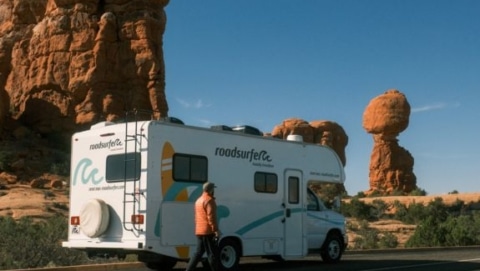
Once the vocabulary stops being a wall, booking gets quick. Filter for the hookup type you need, check the driveway and access fields, confirm the vehicle length, and the rest is choosing between spots that all work.
Browse camper vansTravel smarter with roadsurfer.
Trusted by thousands of travelers worldwide.
✓ Backed by 20,000+ Google reviews
✓ Built for families, couples & adventurers
✓ Inspiration & exclusive deals for subscribers