

Before You Go
Meili Wyss • Last updated: August 7, 2026 • 14 min read
Most people plan a camping trip in the wrong order. There are about six real decisions in a first trip, and the usual approach is to picture the campfire first, then discover in June that everything good for July was booked in January.
That is the actual failure mode. Not forgetting a flashlight. Booking too late, or booking the wrong kind of camping spot and learning about it at the entrance station.
This guide walks through the six decisions in the order you will meet them: what kind of camping you want, where to go, when to book, how to read a reservation listing, what it costs, and what to do once you arrive, from food to setting up camp. You do not need to own any gear to start, and our wider RV travel guides cover the vehicle side once you get there.
Plan a camping trip in six steps, in this order: pick a camping style, pick a destination, book, read the listing, budget, then plan food and arrival. Of the six, booking early matters most, because it is the only one you cannot fix later.
US camping splits into two broad categories. Developed camping means a designated camping spot with facilities, which you usually reserve and pay for. Dispersed camping means camping outside any designated area on public land, typically free and unreserved, with no water, no toilets and no trash service.
| Style | What it means | Typical cost | Good first trip? |
|---|---|---|---|
| Developed (frontcountry) camping | A designated spot with facilities such as restrooms, drinking water, picnic tables and fire rings. Usually reserved. | $12–$56 per night at public parks | Yes |
| Car camping | The National Park Service’s own informal name for developed camping. You drive to the spot and camp there. Usually reserved. | Same as developed | Yes |
| RV camping | Developed camping in a vehicle you sleep in. Some spots add electric, water or sewer connections. Usually reserved. | Same as developed, plus hookup surcharges | Yes |
| Dispersed camping | Camping outside a designated area on national forest or BLM land. No services, no facilities, and no reservation. | Usually free | Not for a first trip |
| Primitive camping | No single federal definition. Can mean a basic reserved spot with a fire ring, or a hike-in spot with nothing at all. Whether you reserve varies. | $10–$15 per night at the parks checked | Once you have a trip or two behind you |
| Backcountry camping | Undeveloped spots not reachable by road, reached on foot, by boat or on horseback. A permit is usually required. | Varies | No |
| Glamping | Not an official term. Outdoor lodging with beds, electricity and indoor plumbing. Reserved. | Highest of the group | Yes, though it is barely camping |
Developed, frontcountry, dispersed and backcountry camping are all defined by federal agencies. Primitive camping has no single federal definition and means different things in different states. Glamping is not an official term. Boondocking is not defined in regulation either, though some Forest Service pages use it as a plain synonym for dispersed camping.
For a first trip, pick developed camping. You get drinking water, a toilet, a flat place to sleep and neighbors who have done this before. Dispersed camping is genuinely good, and it is a poor place to discover that you packed no way to get water.
The real fork is gear. Tent camping for two people means buying a tent, two sleeping bags, two pads, a stove, a cooler, a lantern and a couple of chairs before you have spent a single night outside. Renting an RV skips most of that, because the bed and the kitchen arrive with the vehicle. Whether the trade is worth it depends on how sure you are that you will go again.
If you are weighing it against a hotel instead, we compared the two here: renting an RV versus booking a hotel.

For a first trip, choose somewhere within a half-day drive, then check which agency manages the land. That one fact decides whether you can camp freely, whether you have to reserve, and what you will pay. National forests and BLM land are permissive. National parks are close to the opposite.
| Who manages the land | What you can expect |
|---|---|
| National forest (US Forest Service) | Dispersed camping is generally allowed outside developed areas, free, with no permit. Stay limits are commonly 14 days but are set forest by forest. |
| BLM land | Dispersed camping is generally allowed away from developed facilities, free, usually with no permit, unless a site is posted closed. |
| National park (National Park Service) | The default is reversed. Federal regulation prohibits camping outside designated sites, and permits are commonly required for backcountry trips. |
Grand Teton National Park puts the national park position about as plainly as it can be put: camping is not permitted along roadsides, at overlooks or in parking areas, and sleeping overnight in a vehicle is not allowed anywhere other than a designated camping area.
A few units break that pattern. Death Valley allows roadside backcountry camping along dirt roads, at least a mile down the road from any paved road, with permits required in several named areas. Glen Canyon National Recreation Area allows dispersed camping across much of its backcountry.
Here is the part that sounds like a hedge and is not: check the specific forest, park or field office before you go. Neighboring national forests genuinely disagree with each other. One limits dispersed camping to 14 days in any 28-day period, another to 14 days in any 30, a third simply says the limit is whatever that forest decides. Setbacks from water vary too, from 100 feet inside national parks to 200 feet on some forest land.
For concrete starting points, our guides to camping at the Grand Canyon and Florida state parks with RV camping cover both paths.
Most camping spots on Recreation.gov open for booking six months before your arrival date, and the popular ones sell out within minutes of release. Each location sets its own window, though, so check the specific listing rather than assuming six months applies everywhere.
How much this varies is easier to see than to describe. Glacier Basin Campground in Rocky Mountain National Park, runs four booking windows at once. Group sites open a year ahead. A block of regular spots opens six months ahead on a rolling window. More are released two weeks before arrival, and more again one week before.
Release times matter as much as windows. Most locations go on sale at 7 a.m. Pacific, 8 a.m. Mountain, 10 a.m. Eastern, but not all, and the listing’s Seasons and Fees tab is the only reliable place to check.
Yosemite releases its busiest Valley areas five months ahead on the 15th of the month, and says outright that they sell out within minutes; its smaller areas run on two-week and one-week windows. Acadia’s Blackwoods Campground releases 90% of its spots six months ahead on the first of each month, and holds the last 10% until two weeks before arrival.
Set a calendar reminder for the release date and be at your laptop before the hour, coffee already made. This is the one part of planning where being ten minutes late costs you the trip.
Some camping areas keep spots unreserved and hand them out on arrival, first come, first served. Glacier National Park has five such areas, and its process is typical:
Two honest warnings. These areas fill early on summer weekends, so arriving at 4 p.m. on a Friday in July is optimistic. And availability is seasonal in places you would not expect: Yosemite’s first-come spots exist only from roughly mid-November to early April, and the rest of the year the park tells visitors plainly that arriving without a reservation means leaving the park to sleep. Walk-up is drifting online too, with some parks now releasing same-day spots on the website each morning instead of at a kiosk.
No. They are separate bookings, on separate calendars, sometimes with separate fees. Where a park uses timed entry, those permits release on their own schedule and carry their own processing fee, often around $2, and that schedule rarely lines up with the camping windows at the same park. A camping reservation is not an entry ticket.
Entry requirements also change year to year. Several parks have added timed entry and later dropped it, so check the current policy for the season you are traveling in, not whatever was true last summer. And before you commit: cancelling a Recreation.gov reservation costs $10 withheld from the refund, cancelling inside the cut-off window also forfeits the first night, and not showing up costs $20 plus the first night.
Four fields on a reservation listing decide whether a camping spot actually works for you: the hookup type, the driveway type, the access method, and the maximum vehicle length. Check all four before you pay. Getting any of them wrong can mean arriving at a spot you cannot use.
The vocabulary is genuinely confusing, and the listings do not always use it consistently. Full hookup, pull-through, walk-in and walk-up all mean something specific, and the walk-in label means two different things on different government pages. Our companion guide explains what every field on a listing means, from full hookup to maximum vehicle length.
Expect roughly $24 to $36 a night at the national parks checked for this guide, $12 to $56 at the state parks checked, and nothing at all for dispersed camping on national forest or BLM land. Then add an $8 reservation fee and a park entrance fee. Those extras are where first-time budgets break.
| Cost | Typical amount | Notes |
|---|---|---|
| Nightly fee, national parks | $24–$36 | Yosemite runs $24 to $36 depending on the area. Great Smoky Mountains lists $30 for standard camping spots and $36 for its electric sites. Both re-checked August 2026. This is a two-park sample, not a national average, and the National Park Service does not publish one. |
| Nightly fee, state parks | $12–$56 | Both ends of this range come from Washington, which charges $12 for primitive camping spots and up to $56 for full-utility spots in peak season, and which includes tax in its published figures. New York runs $14 for primitive and $17 for standard, plus surcharges for electric, waterfront and hookups. |
| Dispersed camping | Free | Verified free on Mt. Hood National Forest and on BLM land in Utah. Confirm with the specific forest or field office. |
| Reservation fee | $8 online, $9 by phone, $3 in person | Charged per reservation, not per night. |
| Park entrance fee | $35 per vehicle for 7 days | Zion, Grand Canyon and Acadia all charge this. Separate from the camping fee. |
| America the Beautiful pass | $80 for US residents, $87.50 online with fees. $250 for non-residents | Covers entrance and day-use fees across six federal agencies. Does not cover camping. |
| Non-resident surcharges | Varies | Washington adds $15 per reservation for out-of-state visitors, and New York adds its own per-night surcharge. Some national parks charge non-US residents $100 per person. |
| Private RV parks | Around $70 a night | An industry average from a commercial pricing report, not a government figure. |
| Cancellation | $10, plus the first night inside the cut-off window | No-shows pay $20 plus the first night. |
The America the Beautiful pass does not cover camping. This is the most common cost mistake in camping plans. The pass covers entrance and day-use fees at sites run by six federal agencies, and camping is classed separately as an expanded amenity fee. The Senior and Access passes do discount some camping fees by half; the standard pass discounts none of it.
At $80 for US residents the pass pays for itself across three parks, since entry runs $35 a park. Non-residents pay $250, so that math is different and worth checking against your actual route. Either way, budget your nights separately.
Watch how the fees stack. Three nights at a $30 park spot is $90 for the nights, $8 to reserve and $35 to get through the gate, so $133 before food, fuel or a vehicle. In some states a daily entrance fee sits on top of the camping fee, and a non-resident surcharge on top of that. None of it includes the vehicle, and what an RV rental actually costs swings far more widely than camping fees do.
Four categories cover nearly everything: shelter and sleeping, cooking and water, clothing and light, safety and first aid. The full list runs long enough to deserve its own page, and renting an RV removes most of it, since the bed and kitchen come with the vehicle.
Our complete camping packing list covers it item by item.
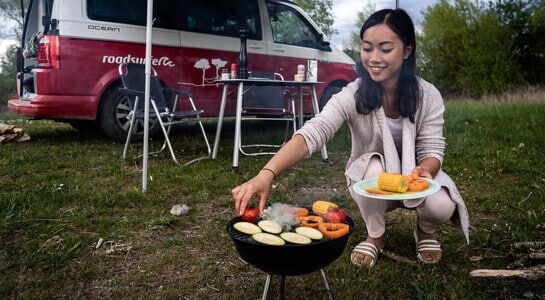
Perishable food must not sit between 40°F and 140°F for more than two hours, or more than one hour when the air is above 90°F. That range is the USDA’s danger zone. The rule shapes a camp menu more than anything else, so build the trip around shelf-stable food and treat the cooler as a short-term tool, not a refrigerator.
Bacteria grow fastest inside that range. A cooler slows this down without stopping it, and no federal agency publishes a figure for how many days a cooler stays safe. The guidance is a temperature, not a duration: keep the contents at 40°F or below, and put a thermometer inside so you know.
What actually keeps a cooler cold, according to USDA and FDA guidance:
For food that needs no cooler at all, the USDA publishes its own camping list: pre-packaged shelf-stable meals, peanut butter in plastic jars, canned tuna, ham, chicken and beef, dried noodles and soups, beef jerky, dehydrated food, dried fruit and nuts. One caveat catches people out. Not every can is shelf-stable, and some canned hams and seafood are labeled “keep refrigerated,” so read the label instead of trusting the can.
When you cook, use a thermometer, not color. Ground meat needs 160°F, poultry 165°F, and pork and beef steaks 145°F followed by a three-minute rest.
Three water rules are worth memorizing. Taps in developed areas are safe to drink unless a notice says otherwise, though a few areas have no drinkable water or supply it only in summer.
Never fill a fresh water tank at a dump station. In Indiana, for example, the tap beside one is legally required to carry a sign saying the water is unsafe to drink, and the same hazard applies everywhere. Water from a lake or stream needs treating even when it runs clear: a rolling boil for one minute, or three minutes above 6,500 feet.
Arrive in daylight, park or pitch first, then deal with food storage before anything else. In bear country, food storage is a federal regulation rather than a suggestion. Chairs, lights and the fire can all wait until the food is locked away.
Late arrival is harder than beginners expect. Hunting for a numbered post with a flashlight while trying not to wake the neighbors is a bad introduction to camping, and quiet hours start at 10 p.m. at most parks and run to 6 a.m. Aim to pull in with two hours of light left.
Quiet hours and generator hours are two different restrictions, and generator hours are the stricter one. Four federal camping areas checked for this guide published four different schedules. Some list the hours when generators are allowed, often a two-hour block morning and evening. Others list when they are banned, and some restrict generators to particular loops.

Great Smoky Mountains also bans charging a battery by idling the engine in its generator-free areas. Worth knowing if you planned to keep a fridge running that way.
Fires go in the established fire ring and nowhere else. Firewood rules differ in ways that are easy to get wrong: Great Smoky Mountains allows only heat-treated wood certified by the USDA or a state agency, while Yosemite asks visitors not to bring wood from more than 50 miles away. The Forest Service message is simpler. Buy it where you burn it, because moving firewood moves insects and disease with it.
Fire restrictions change through the season and are issued locally with expiry dates. Check the managing forest or park’s alerts page in the week before you travel, rather than relying on what a guide said in advance. Including this one.
Store all food and anything scented in the metal locker at your spot, 24 hours a day. In bear country this is enforceable federal law, not camp etiquette. Yosemite publishes a fine of up to $5,000, and rangers can impound food or a vehicle left out.
Some parks accept a hard-sided vehicle instead of a locker, but the rules differ enough that you have to check. Yosemite allows food inside a vehicle out of sight during daylight only, and requires it in a locker after dark. Sequoia and Kings Canyon tell campers to remove everything from a car or truck.
The part people get wrong is what counts as food. At Yosemite the list includes canned goods, bottles, drinks, soap, cosmetics, toiletries, trash, and ice chests even when empty and even when the cooler is certified bear-resistant. Sequoia and Kings Canyon add sunscreen, insect repellent, candles, air fresheners, cleaning products, pet food, tobacco and baby car seats. Great Smoky Mountains requires water containers to be stored too, along with every pot and stove used to prepare food.
Read all that as one working rule: if it has a smell, it goes in the locker. Latch the locker fully every time, including in the middle of the day.
The 3-3-3 rule is a popular RV travel habit, not an official rule: drive no more than 300 miles a day, arrive before 3 p.m., and stay at least three nights. No government agency or RV association publishes it, and no source names where it came from. The idea underneath it holds up anyway, because arriving in daylight and staying long enough to unpack are what actually make a trip easier.
The 4-4-4 rule is an unofficial camping and RV travel habit: drive up to 400 miles a day, arrive by 4 p.m., and stay four nights at each stop. Like the 3-3-3 version, it has no authoritative source behind it. Versions using 2-2-2 and 3/300 also circulate, which is a good clue that there is no original to trace.
The 200 rule refers to Leave No Trace guidance to stay roughly 200 feet away from lakes and streams. Leave No Trace treats that distance firmly for waste, dishwashing and bathing, and describes it as a recommended rule of thumb for where to pitch. The organization does not itself use the phrase “the 200 rule.” Read the seven Leave No Trace principles before a first trip.
The seven C’s of camping are care, caution, courtesy, cleanliness, cooperation, conservation and common sense. They come from the Camper’s Code of Ethics published by the North American Family Campers Association, a volunteer organization that has united camping enthusiasts since 1957. A different and unrelated seven-C packing list also circulates online, so the phrase gets used two ways.
Check for cancellations daily, then widen the search to first-come, first-served areas and to national forest or BLM land nearby. Yosemite tells visitors outright to search Recreation.gov frequently, because spots do open up when other people’s plans change. Dispersed camping on national forest land is the dependable fallback: usually free, no reservation, and often a short drive from the park you wanted.
More on planning, packing and living well on the road.
Book earlier than feels necessary. The budget is manageable, the gear is solvable, and every rule in this guide is published somewhere you can check. Availability is the only piece that closes behind you, so work backward from the release date instead of forward from the trip.
Find a camper vanTravel smarter with roadsurfer.
Trusted by thousands of travelers worldwide.
✓ Backed by 20,000+ Google reviews
✓ Built for families, couples & adventurers
✓ Inspiration & exclusive deals for subscribers