Choose Your RV

Meili Wyss • Last updated: December 5, 2025 • 8 min read
A straightforward guide to RV rentals: define your trip, calculate true total cost, and avoid surprise charges. When you search for “RV rentals near me,” you’ll see a mix of prices, providers, and vehicle types that all look similar. This guide gives you a simple way to compare those offers so you know what you’re really paying for before you book. If you’re also comparing RV classes or planning your very first rental, our RV guides hub brings together explainers on Class A, B, and C, plus planning and travel basics. Here, we’ll stay focused on one thing: how to find RV rentals near you that match your trip, fit your budget, and don’t hit you with surprise fees at the end.
To find the best RV rentals near me without overpaying, define your trip (dates, group size, rough route), shortlist a few nearby providers, then compare total trip cost instead of just the daily rate. Check what’s included, read recent reviews, and watch for fees buried in the fine print.
Quick checklist:
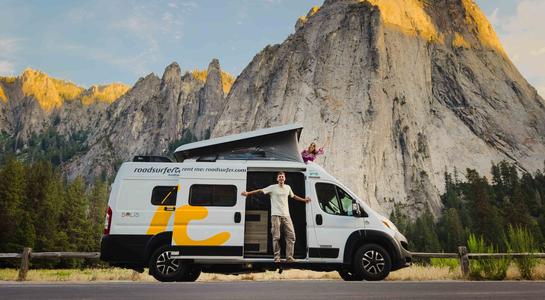
The fastest way to avoid overpaying is to know exactly what matters for your trip—space, sleeping setup, and how you’ll actually use the RV day to day.
Start with the basics:
Trip type matters: A couple on a three-day trip needs something very different from a family of four on a 10-day national parks loop.
Route matters too: Tight streets and small parking lots feel very different in a large RV than in a compact one. If you expect city driving, maneuverability often matters more than people think.

Here’s a quick side-by-side look at how Class B and Class C RVs differ so you can choose the right fit for your trip.
Mileage rules, insurance, fees, add-ons, seasonality, and what’s included can make two similar-looking RVs cost very different amounts once everything is added up.

Mileage rules
Fuel, generator use & camping spots
Add-ons & inclusions
Vehicle + timing
Insurance + protections
Deposits & returns
Mandatory fees
A simple way to compare offers is to use a rough formula: total trip cost ≈ (daily rate × nights) + estimated miles + insurance + mandatory fees + expected add-ons.
Fuel, camping spot fees, and food apply to most road trips, but adding rough estimates helps you compare RV rentals near you with fewer surprises.

Lowest total cost, basic perks
Nightly rate: $150
Miles: Unlimited
Insurance: $40 per night
Mandatory fees: $150 (cleaning + prep)
Perks: Basic camping gear, roadside assistance
Total: (4 × $150) + (4 × $40) + $150 = $600 + $160 + $150 = $910
Mid-range price with valuable perks
Nightly rate: $130
Miles: Unlimited
Insurance: $25 per night
Mandatory fees: $300 (includes cleaning deposit and one-way drop-off)
Perks: Free second driver, included camping gear, roadside assistance
Total: (4 × $130) + (4 × $25) + $300 = $520 + $100 + $300 = $920

Cheapest nightly rate, most expensive overall
Nightly rate: $120
Miles: First 200 miles included, then $0.40 per mile
Insurance: $30 per night
Mandatory fees: $200 (higher prep + admin fees)
Perks: None
Extra miles cost: 400 × $0.40 = $160
Total: (4 × $120) + (4 × $30) + $160 + $200 = $480 + $120 + $160 + $200 = $960
On paper, Quote B looks cheapest by nightly rate, but it becomes the most expensive once you add mileage and fees. Quote A has the lowest total cost, while Quote C costs slightly more but includes perks that can save money elsewhere. That’s why comparing full trip cost—and not just the nightly rate—matters if you want an affordable RV rental instead of a cheap-looking option that blows your budget later.
If you want to go deeper and compare RV rentals with traditional trips, our RV Rental vs. Hotels & Flights guide includes an RV rental calculator you can use as a template.
To compare RV rental offers without overpaying, shortlist a few suitable RVs, run the same total trip cost for each (nightly rate, miles, insurance, fees, and add-ons), and then compare what’s included, reviews, and return rules instead of just picking the lowest nightly price.
Step 1: Shortlist realistic options
Start by narrowing down your choices to a few RVs that actually fit your trip. Skip anything that doesn’t work for your group size, sleeping layout, pickup timing, or driving range—you’ll only waste time comparing options you’d never book.
Step 2: Compare the real total cost
Nightly rates don’t tell you much. To compare options fairly, run the same simple formula for each RV:
total trip cost ≈ (daily rate × nights) + estimated miles + insurance + mandatory fees + key add-ons
Step 3: Check what’s included—and what isn’t
A slightly higher base price can end up cheaper if it includes things you’d otherwise pay for separately. When comparing rentals, look closely at the details:

If you want a quick breakdown of what roadsurfer includes by default, our “Why rent from roadsurfer?” FAQ outlines the perks, equipment, and policies that come standard with each rental so you can compare providers on equal terms.
Before you reserve an RV, it’s worth skimming the rules that affect what you’ll pay at drop-off. Fuel, waste tanks, cleaning, and timing sound minor, but they’re where most surprise fees come from.
A low nightly rate can cost more overall if the quote comes with:
Focus on reviews from the last 6–12 months and look for:
Repeated problems are a reason to move on, even if the price looks good.
To find RV rentals near you that actually fit your trip, compare local companies, larger rental brands, and peer-to-peer listings. Filter them by pickup location, vehicle type, clear pricing, and straightforward rules instead of just clicking the first result.
As you scroll through options, filter with a few practical questions in mind:

Once you’ve found two to four options that work on paper and are within a reasonable driving radius, that’s when your cost comparison and review checks really matter. The search results are just the starting point—the real “best” RV rental near you is the one that fits your trip, your budget, and your tolerance for surprises.
The same method works for any RV trip, but what counts most—size, mileage, flexibility, or price—shifts with your group and route.



If you work through this guide, use the example math, and run your own numbers with a simple worksheet or calculator, you’ll be in a much better position to pick an RV rental near you that actually matches your trip—and your budget—without guessing what’s hiding in the fine print.
If you define your trip first, compare the full trip cost instead of just the nightly rate, and sanity-check what’s included, you’re already ahead of most people searching for “RV rentals near me.” Line up a few realistic options, run the same numbers for each, and use recent reviews as your reality check for cleanliness, support, and surprise fees.
From there, it’s just choosing the RV that fits your group, your route, and your budget – so you can focus more on the trip itself and less on worrying about what’s hiding in the fine print.

Booking an RV rental at least 2–3 months in advance usually gives you the best price and availability. Popular travel periods like summer and holidays often sell out early, so the longer you wait, the higher the prices tend to climb.
Yes, RV rentals are often cheaper when picked up outside major cities or airports. Urban and high-demand locations typically charge higher base rates and add-on fees, while suburban or secondary locations can be significantly more affordable.
The best way to compare RV rental companies is to look at total trip cost, not just the daily rate. Consider mileage rules, insurance requirements, cleaning fees, and included equipment to avoid misleadingly low base prices.
RV rental prices rarely drop dramatically at the last minute, and they often increase as availability shrinks. You might find occasional short-notice deals in low-season months, but relying on last-minute discounts is a risky strategy.
A small Class B RV or compact Class C is usually the easiest size for beginners to rent and drive. These models handle more like large vans, fit into standard parking spaces, and reduce stress when navigating cities or tight roads.
From picking the right RV class to planning routes and camping spots, our RV guides hub pulls everything into one place so you don’t have to piece it together from scratch.



Travel smarter with roadsurfer.
Trusted by thousands of travelers worldwide.
✓ Backed by 15,000+ Google reviews
✓ Built for families, couples & adventurers
✓ Inspiration & exclusive deals for subscribers