Choose Your RV


Meili Wyss • Last updated: February 05, 2026 • 7 min read
When people imagine RV America, they often picture a single coast-to-coast drive. In reality, RV travel across the U.S. works very differently: “across America” usually means a multi-state route shaped by daily driving limits, overnight availability, and access to destinations like national parks—not racing to cover distance. This guide breaks down what RV travel across America actually looks like, from realistic driving days and route design to costs and vehicle constraints. For broader planning basics, the RV guides hub is a helpful place to start.
Most RV trips across America are point-to-point, multi-state journeys with daily drives of 200–300 miles, planned overnight stops, and routes shaped by where RVs can realistically park and stay. Successful trips prioritize pace and access over distance, often focusing on regions, coastlines, or national park corridors rather than a single coast-to-coast sprint.

RV travel is popular in the U.S. not because of sheer distance, but because it simplifies long, flexible trips.
RVing across America is less about total distance and more about aligning a few non-negotiable planning factors. Trips feel manageable when driving limits, route direction, overnight logistics, and RV size are coordinated from the start.
Most long-distance RV trips work best with 200–300 miles per day.
Point-to-point routes are the default for RV travel across America.
Overnight planning determines daily driving distance.
RV size directly affects access.
For many national park trips, camper vans are often more practical than larger RVs. The difference comes down to access and mobility, not comfort alone.
In RV terms, this often means choosing between a Class B camper van and a larger Class C motorhome. If you want a clear breakdown of how those options compare, our Class B vs. Class C RV guide explains the differences in size, layout, and travel style.

Coastal routes are one of the most common long-distance RV formats. These trips move steadily in one direction, keep daily drives reasonable, and rely on well-spaced overnight options. A classic example is traveling from Seattle to San Francisco along the Pacific Coast, which shows how multi-state RV travel works without trying to cross the entire country.

Interior routes often revolve around national parks, where access rules and overnight availability shape the trip more than mileage. These routes usually cover fewer states but require tighter planning. A typical example is traveling from Salt Lake City toward Yellowstone, where park entry points largely determine daily distances.
RV travel costs scale with time and structure, not just distance.
There’s no single average price. A slower, multi-week trip with frequent stops often costs more than a faster route covering more miles. Daily rental rates usually form the largest expense, while fuel and overnight stays add steady, predictable costs. Cooking on the road shifts food spending rather than eliminating it.
This is why comparisons like RV rental vs. hotels and flights are most useful when evaluated across the full trip, not day-by-day.
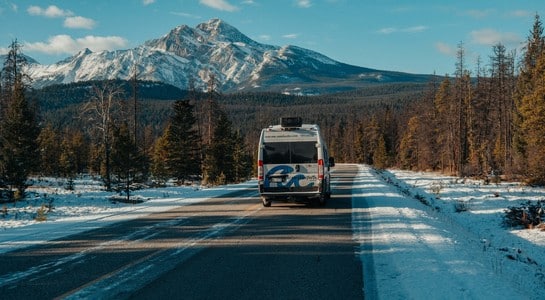
Yes—but usually as a multi-state route, not a nonstop coast-to-coast drive.
Most RV travelers aim for about 200–300 miles per day.
For long-distance RV trips, overnight planning is usually necessary.
Yes—RV size directly affects access and route flexibility.
From picking the right RV class to planning routes and camping spots, our RV guides hub pulls everything into one place so you don’t have to piece it together from scratch.


Travel smarter with roadsurfer.
Trusted by thousands of travelers worldwide.
✓ Backed by 15,000+ Google reviews
✓ Built for families, couples & adventurers
✓ Inspiration & exclusive deals for subscribers