

Week-Long Trips
Meili Wyss • Last updated: April 2, 2026 • 9 min read
A Route 66 road trip itinerary is not about following a single continuous road. Much of Route 66 no longer exists in one piece, and trying to trace it exactly often means missing the best stops. The experience comes from the contrast between structured towns, preserved landmarks, and more remote stretches. This Route 66 road trip itinerary shows you where to stop, how long it takes, and how to plan your route without turning it into a checklist. For a deeper breakdown of timing and trade-offs, see this Route 66 road trip planning guide. Traveling by RV gives you the flexibility to adjust your pace.
Route
Chicago ➝ Pontiac ➝ Tulsa ➝ Amarillo ➝ Tucumcari ➝ Albuquerque ➝ Holbrook ➝ Kingman ➝ Amboy ➝ Santa Monica
Distance
~2,400 miles
Trip Duration
2–3 weeks
Best For
First-time Route 66 road trip travelers
Best Time
April to June / September to October
Trip Style
Iconic stops + flexible pacing
This Route 66 road trip map follows the full route from Chicago to Santa Monica, highlighting the main stops from this itinerary along the way. Use it to plan your drive, see how each section connects, and decide where to stop based on your time and interests.
Chicago → Pontiac · 100–110 miles · 1.5–2 hours drive
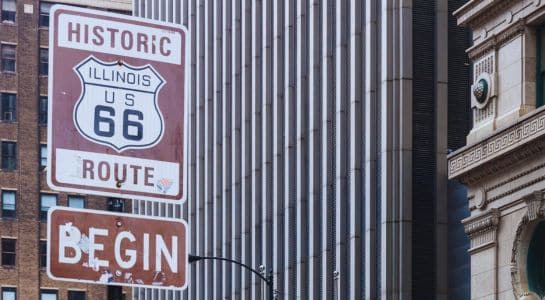
Route 66 begins in downtown Chicago at the official “Begin Route 66” sign at E Adams St & S Michigan Ave. With the iconic sign and a straightforward route out of the city, it’s easy to start your journey without confusion. As you leave Chicago, the drive quickly shifts into smaller towns and classic roadside stops.


Best for
Things to do
Recommended stay: Half a day to 1 day is enough to cover the key stops without slowing down your overall Route 66 road trip itinerary.
St. Louis → Galena · ~300 miles · 4.5–5 hours drive
Yes, many travelers skip parts of Missouri and Kansas because this stretch works more as a transition than a core highlight on a Route 66 road trip itinerary. With longer gaps between stops and fewer clusters of attractions, most focus on a few key places instead of driving every mile. Driving Route 66 here feels less structured, so it’s easy to move through quickly while prioritizing the more iconic parts of the route.


Best for
Things to do
Recommended stay: Half a day to 1 day is usually enough if you focus on a few key stops.
This section marks the transition out of the route’s most structured stretch, where stops become more selective and driving Route 66 feels less continuous.
Tulsa → El Reno · ~130 miles · 2–2.5 hours drive
Route 66 in Oklahoma feels less curated and more original, with longer stretches of uninterrupted driving and fewer but more distinctive stops. For many Route 66 road trip itineraries, this is where the pace slows and the focus shifts to driving Route 66 itself. With smaller towns and older roadside businesses, this stretch feels closer to the historic character of the route.


Best for
Things to do
Where to eat
Hidden gems
Recommended stay: 1 to 2 days works best if you want time for both Tulsa and El Reno without rushing.
This section shifts into fewer, more distinctive stops, with longer stretches where driving Route 66 becomes the main part of the experience.
Amarillo → Adrian · ~50–60 miles · 1–1.5 hours drive
The easiest stretch of Route 66 to drive is between Amarillo and Adrian, where several key stops are grouped closely together. For many Route 66 road trip itineraries, this section stands out for its efficiency, making it easy to cover multiple highlights in a short time. Driving Route 66 here feels more compact and predictable, with shorter gaps between stops..


Best for
Things to do
Recommended stay: Half a day is enough to see the main stops without extending your Route 66 road trip itinerary.
This is the most efficient stretch of the route, where driving Route 66 feels straightforward and multiple highlights can be covered quickly.
Tucumcari → Albuquerque · ~170–180 miles · 2.5–3 hours drive
Route 66 in New Mexico is defined by longer scenic drives and fewer stops, with towns spaced farther apart across desert landscapes. For many Route 66 road trip itineraries, this is where the focus shifts from constant attractions to the experience of driving Route 66 itself. Tucumcari’s neon motels and Albuquerque’s long preserved stretch stand out along this more open, atmospheric section.

Best for
Things to do
Recommended stay: 1 to 2 days works best if you want time to experience both Tucumcari and Albuquerque without rushing.
This is where driving Route 66 slows down, with longer stretches where the road and landscape become as important as the stops.
Holbrook → Kingman · ~185–195 miles · 3–3.5 hours drive
Stop 6: Arizona
Route 66 feels most like the classic road trip in Arizona, where preserved towns, desert scenery, and long stretches of the original road come together in one section. For many Route 66 road trip itineraries, this is where the experience feels most complete, with a strong balance between driving and well-preserved stops. Driving Route 66 here means moving easily between iconic scenery and historic towns along a route that feels connected and true to its original character.


Best for
Things to do
Recommended stay: 2 to 3 days works best if you want time to explore both towns and longer driving segments without rushing.
This is one of the most complete sections of the route, where driving Route 66 brings together scenery, towns, and historic road segments in a way that feels closest to the ideal version of the trip.
Amboy → Santa Monica · 235–245 miles · 4–5 hours drive
Route 66 officially ends at the Santa Monica Pier, where the route reaches the Pacific Ocean and completes the full Route 66 road trip itinerary. For many travelers, this is the most recognizable endpoint, marked by the iconic “End of the Trail” sign. Driving Route 66 into Los Angeles shifts from open desert roads to a more urban setting, ending at the coastline with a clear finish.


Best for
Things to do
Recommended stay: 1 to 2 days works best if you want time to complete the drive and spend time at the Santa Monica endpoint.
This final section moves from long, open desert driving into a defined ending, with the Pacific Ocean marking the completion of the Route 66 road trip.
You can start a Route 66 road trip in Chicago, Los Angeles, Phoenix, or Dallas, depending on how much time you have and which parts of the route you want to prioritize.
Chicago is the official starting point and best suited for travelers with 2–3 weeks who want the full progression from Midwest towns to the California coast.
Los Angeles or Phoenix are more practical starting points if you want to focus on the most iconic stretches without committing to the full distance. These routes concentrate landmarks like desert landscapes, historic motels, and roadside attractions into a shorter timeframe.
Dallas offers a middle ground, with access to central sections of Route 66 and flexibility to extend your trip in either direction.
Most travelers don’t drive all 2,400 miles, and skipping less distinctive sections does not take away from the experience.
You don’t need to drive the full Route 66 to have a complete experience, and most travelers focus on selected sections instead. Most travelers don’t, and some of the most memorable stretches happen in shorter segments rather than the full cross-country route.
If you have the time, driving Route 66 from Chicago to Santa Monica gives you the full progression, from preserved Midwest towns to open desert highways. But if you’re working with a tighter schedule, starting in the Southwest gives you a higher concentration of iconic stops with less driving between them.
The only real decision is where to begin and how much ground you want to cover. Once that’s clear, the rest of the trip becomes easier to shape around your pace.
The most popular Route 66 stops are Cadillac Ranch, Blue Whale of Catoosa, Santa Monica Pier, and Petrified Forest National Park.
These locations are widely recognized, easy to access, and consistently included in most Route 66 road trip itineraries. If you are short on time, focusing on these stops will give you a strong version of the experience without needing to drive the entire route.
No, Route 66 is not fully drivable as a continuous road today.
Many original sections have been replaced, rerouted, or no longer maintained, so you will need to follow a Route 66 road trip map and occasionally use modern highways. This is especially common in California and parts of the Southwest.
Most travelers need 2 to 3 weeks to complete a full Route 66 road trip from Chicago to Santa Monica.
If you have less time, you can shorten the trip by focusing on the Southwest, where stops are closer together and more visually distinct. Many travelers choose this option instead of driving the full 2,400 miles.
You can start in Chicago for the full route or begin in the Southwest for a shorter, more concentrated trip.
Starting in Chicago gives you the full progression of the road, while starting in Texas, New Mexico, or Arizona reduces driving time and focuses on the most recognizable stops. Most travelers choose based on how much time they have.
No, you do not need to drive the entire route to get the full experience.
Some sections, particularly in the Midwest, are less dense in major stops. Skipping parts of the route and focusing on key regions will still give you the most memorable parts of driving Route 66.
No, planning every stop in advance is not necessary for a Route 66 road trip.
A general route is enough. Some of the most memorable parts of the trip come from unplanned stops, small towns, and roadside attractions you would not include in a strict itinerary.
Travel smarter with roadsurfer.
Trusted by thousands of travelers worldwide.
✓ Backed by 20,000+ Google reviews
✓ Built for families, couples & adventurers
✓ Inspiration & exclusive deals for subscribers